
Auto Intelligence
The Next Ten Years of AI

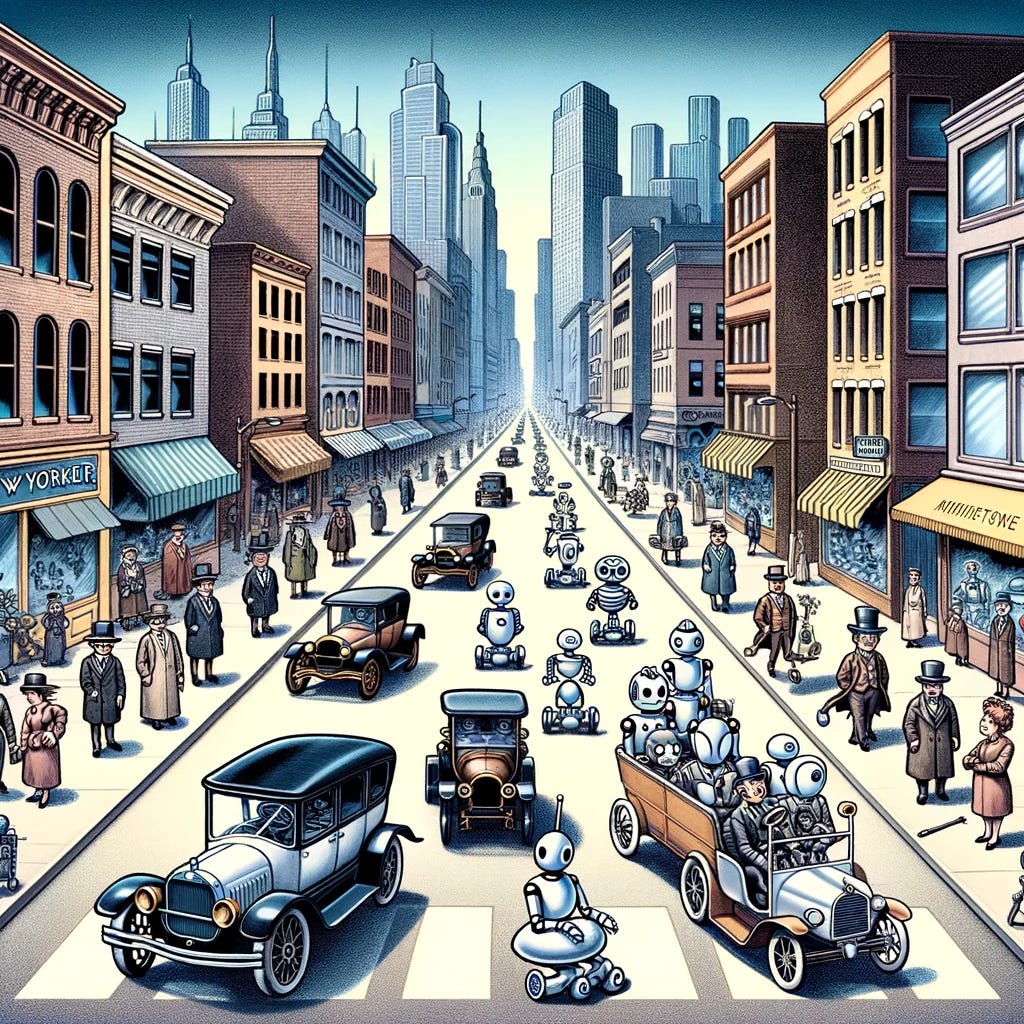
“What a computer is to me is it’s the most remarkable tool that we’ve ever come up with, and it’s the equivalent of a bicycle for our minds.” - Steve Jobs
The discourse around the future of AI tends toward the vague. Detractors fear AI will take their jobs or, in some particularly bleak scenarios, their lives; proponents argue that AI will empower us all. Neither camp is very specific. In the here and now, market analysts talk about Nvidia or Microsoft; investors talk about the OpenAI tender offer; engineers talk about the latest Arxiv paper.
The specific nature of the adoption will be defined in part by companies and tools being built today as a thousand different theses play out in real time. I want to offer mine here: the best analogue to the invention and adoption of AI is the invention and adoption of the automobile.
Automobiles are a great analogue to AI. They come in all shapes and sizes, everyone is familiar with them, they constitute an enormous part of our industrial capacity and capital stock, and their introduction was enormously impactful. Autointelligences will be the same.
This frame should be reassuring to those who are fearful. Automobiles are by and large a popular and useful tool. The adoption of the automobile was disruptive, but it didn’t end life on earth. Nor will the adoption of autointelligence.
It’s also, however, a check on those who urge no-holds-barred acceleration of AI. Automobiles and automobile infrastructure destroyed American inner cities, emitted enormous amounts of pollutants, drove demand for oil dependency and, consequently, petro-dictatorships. To this day, over 40,000 Americans are killed every year in automobile accidents. If autointelligence starts killing 40,000 Americans per year, I doubt it will be seen as a success.
But to an industry which has been lobbying for some form of regulation, via House hearings and CEO diplomacy, automobiles also present a legal frame for AI. Car use is heavily regulated via licensing and mandatory insurance; a Department of Motor Vehicles exists in every county in America. We evolved these controls over time, as automobiles were adopted, and we’ll do the same with autointelligence.
The Golden Spike and The Model T Moment
“I saw an automobile once when I was a kid. Now they’re everywhere.” - Brooks, The Shawshank Redemption
In 1908, the first Ford Model T rolled off the line in Detroit; by 1927, Ford had built 15 million. It was watershed moment for industrial locomotion.
But it was hardly the first milestone. The transcontinental railroad had been finished almost 40 years early, when Leland Stanford ceremonially tapped in the Golden Spike in Utah. Americans had been taking trains across the country for decades before Ford made cars available to everyone.
OpenAI’s launch of ChatGPT was likely our Model T Moment: a powerful conversational AI, easily accessible, arrived in the hands of everyday Americans.
But we’ve been living through the railroad era of AI since at least the dot com boom. Automated systems have proliferated and become faster, cheaper and better. Captains of industry have accumulated railroad-era levels of wealth, mostly in the vicinity of Stanford’s eponymous university.
Why is this relevant? The following points:
We are not going from 0 to 1 on AI. We are following a ~linear pattern of growth.
We already use AI at mass scale, and we already regulate it. The various algorithms powering Facebook have been heavily used, heavily scrutinized, and heavily regulated. The same is true for Google etc.
Moving from industrial scale algorithms to personal AI may be as big a change as moving from railroads to cars. But it’s not as if we’re moving from covered wagons to cybertrucks.
A Taxonomy of Automatic Intelligence
Let’s dig in with some examples. The following lists compare current AI tools to their automobile equivalents. This is a handy frame to ground our expectations about AI in what we’re already familiar with.
Autointelligence<>Automobile analogues of “the railroad era”:
Linear Regressions<>Wheels. Suspend your disbelief here. Linear regressions are wheels: basic and foundational.
Recommender Systems<>Trains. Yup, recommender systems are trains. These are what tell you what to watch on Netflix or what to buy on Amazon. Big, clunky and expensive.
On Device Models<>Bicycles. Whether iPhone, Android or a secret third thing, there are small ML models running on your phone. They’re useful and relatively cheap. They may be personalized or use personal data, but they’re small, so it’s kind of like owning your own bike.
That’s more or less fine for systems that are already widely in use; you get the idea. Let’s look next at evolving businesses and business models in the LLM / AI space.
Autointelligence<>Automobile analogues of the nascent AI boom:
ChatGPT<>Uber for Intelligence. OpenAI isn’t selling machines. It’s selling access to machines, and intelligence as a service. I pay 20$ a month for access to ChatGPT, and more per token if I want to use the API. I own nothing. Additionally, I and every other OpenAI customer are using the exact same AI! It’s very democratic and equitable, but it’s also very general and unspecialized.
Cloud GPUs<>Parking Spots. I also pay a large fee every month to Google Cloud, from whom I rent a GPU. I don’t own the hardware, but I do own the code that it’s running. I can tweak this code how I want and tune models as I please. Kind of like a parking spot in Manhattan, it’s something of a hobbyist luxury, best used for weekend trips to the Hamptons.
Model Weights<>Car Factories. This is an interesting one; my idea here is that both the model weight training process and the process of building a factory involve an enormous capital investment. Once complete, you can sell your products.
Actual GPUs<>Steel. Cars, and car factories, require steel, and AIs require GPUs. This business model is more straightforward as of now, because it doesn’t require consumer adoption, just the expectation of consumer adoption.
The list above belies a great deal of complexity, but I think it’s a helpful intro to the concept: we can learn a lot about autointelligence via analogy to automobile. There’s a similar breadth of complexity and interconnected parts.
Speciation and Specialization
To date, we can make assertions about the large scale AIs-as-a-service: ChatGPT is so chatty. Claude is eager to please. Sydney Bing was overly emotional. We are operating under the assumption that we have one AI per company.
A leap most people will need to make is towards consistently personified, or consistently specialized, AI. This is the AI of the type we see in science fiction films: an entity with its own personality and skillset.
The process of creating this entity is complicated, and there will be various markets for development and sales. Let’s start with the high end.
Imagine you’re a Saudi royal or the insouciant scion of a Swiss watchmaking clan. You like to own expensive things - the best. You don’t particularly like to work hard - who does? And you may lack the temperament to build your own AI.
Renting the same golf cart as everyone else from OpenAI will not be sufficient. You’ll want a personal AI with the works, even if it costs 200K up front and 10K a month thereafter. For the price, you’ll get a personal assistant many times more powerful, running on dedicated hardware. It’ll tell you jokes, gossip with you, plan outings with your friends, and play video games.
This is the sports car of AI: flashy, powerful, but somewhat impractical.
Imagine instead that you’re a small business owner. You might be willing to spend a similar amount of money, but you need it to make money. You might expect it to handle your bookkeeping and pay the bills on time, negotiate with the suppliers. The analogue here is more like a company van, or a pickup truck: a powerful machine with a specific purpose, not “fun”, but useful and productive.
We can go on, in a similar vein as my lists above:
Small AIs running on your phone or computer are sleek motorcycles (as opposed to the bicycles we have today)
Tanks: government H100 clusters running military analysis and war games
Police cars: watchdog AIs monitoring urban traffic cameras
Ambulances: diagnostic AIs used in hospitals
Eighteen wheelers: whatever the AI-powered recommender systems of the future are
You might make a more anthropomorphic analogy and just describe the AIs as people: an AI doctor rather than an AI ambulance, an AI detective rather than an AI cop car. I’m sure many people will do so. To me, this neglects their fundamentally mechanical nature.
Is specialization guaranteed? No, but I posit the following:
AI quality will always be a function of cost
AI skills will transfer imperfectly across domains
If these statements hold, specialization is inevitable: higher end users will be willing to pay more for more domain specific tasks. And the speciation of AIs will result.
Zero to Sixty
On valence, I think AI will be a good thing. On magnitude I think, in the scheme of things, it’s likely to be less impactful to modern life than the automobile. I don’t think AI is likely to kill 40,000 Americans at any point in the next hundred years, let alone kill that many per year. I’m optimistic that AI will lead to advances in medicine and science. AI has enormous potential in many, many ways.
But we’re at an inflection point. If modern American cities had been less enthusiastic about adopting car centric infrastructure, they might not have experienced such rapid decay. We might look back at a deadened job market for white collar professionals and feel similarly. Americans should continue to examine the development of AI with a cautious lens.